- Ground floor breast
- £1,500 – £3,000
- Both floors, stack kept
- £3,000 – £5,000
- Full chimney removal
- £4,500 – £6,500+
- Engineer's calculations
- From about £300, commonly £300 – £600
- Building Control fee
- A few hundred pounds, set by each council
Chimney breast removal prices in 2026
These are typical guide prices drawn from published 2026 cost guides, not quotes. Tall terraces, shared stacks on party walls and awkward access push prices towards the top of each range or beyond it.
| Job | Guide price |
|---|---|
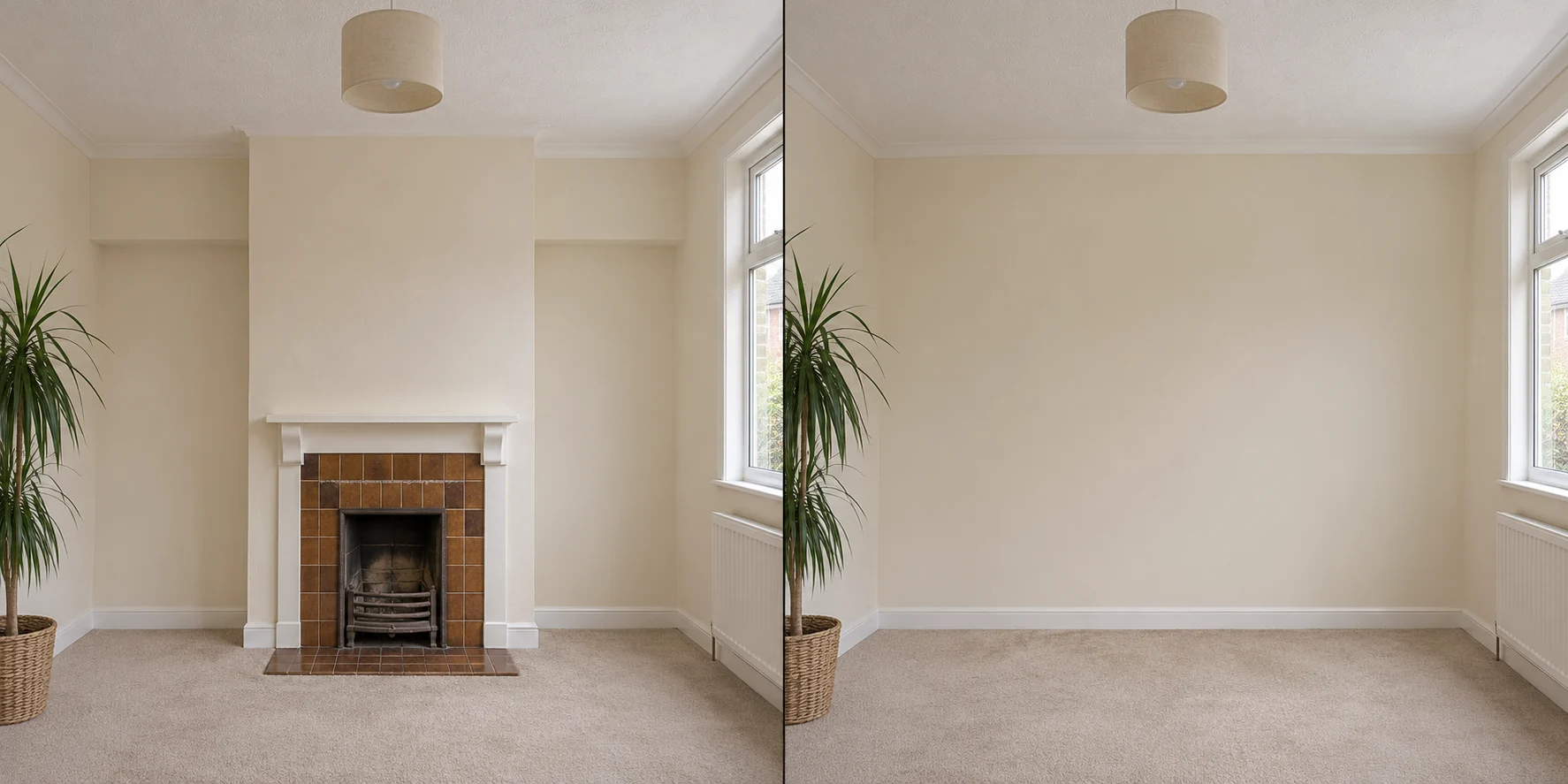
| Ground floor breast only, with support for the chimney above | £1,500 – £3,000 |
| First floor breast only | £1,750 – £3,200 |
| Both floors, stack kept and supported in the loft | £3,000 – £5,000 |
| Full chimney removal: stack and all breasts | £4,500 – £6,500+ |
Guide ranges from published 2026 cost guides. Brighton and the South East usually sit in the upper half.
| Item | Guide price |
|---|---|
| Structural engineer's calculations | From about £300, commonly £300 – £600 |
| Building Control fee | Set by each council's fee schedule, typically a few hundred pounds |
| Building Control, one published example (Brighton & Hove City Council) | £269.50 building notice (incl. VAT); £334.25 regularisation (VAT exempt) |
| Chimney scaffold, two-storey house (only if the stack is touched) | £800 – £1,500, up to about £2,500 for difficult access |
The example is from Brighton & Hove City Council's building regulations application fees table. Every council sets its own fees and they change, so check the table for the council where the house is.
What makes chimney breast removal cost more or less
The biggest single factor is what has to hold up the chimney you keep. After that, it is how many floors, how much making good, and how hard it is to get rubble out of the house.
- Beam or brackets. Where Building Control accepts gallows brackets, they are quicker and cheaper to fit than a steel beam. A beam needs padstones, more temporary propping and often lifting floorboards or working in the loft.
- Number of floors. Each extra breast adds demolition, rubble and making good. Removing breasts on both floors moves the support into the loft, which adds access work.
- Shared stacks. A breast back to back with the neighbour's adds party wall costs and may rule out brackets.
- Wall construction. Soft or mixed walls, such as rubble-filled or flint walls in older houses, can mean a more substantial support design and more opening up.
- Finish. A plain skimmed ceiling is cheap to patch; a run plaster cornice in a Victorian front room is not. Matching original floorboards where the hearth was also adds time.
- Access and rubble. A breast on the second floor of a narrow terrace with no rear access means every bag carried through the house. A skip on the road may also need a licence.
Example chimney breast removal costs
These examples are illustrative only. They show how the guide prices combine on house types common in Brighton, Hove and East Sussex, not jobs we have done.
Victorian terrace: both floors, shared stack kept
A two-storey terrace with the front breasts back to back with next door's on the party wall. Both breasts come out and the stack is carried on a beam in the loft. Expect the building work in the £3,000 to £5,000 range, likely the upper half given access and the party wall, plus engineer's calculations (£300 to £600), the council's Building Control fee, and party wall surveyor costs if the neighbour does not consent. A realistic all-in budget lands somewhere around £4,500 to £6,500 before redecoration.
1930s semi-detached house: ground floor breast only
The family wants a wider front room. The first floor breast and stack stay, supported on a beam at ceiling level. The building work sits in the £1,500 to £3,000 range, plus engineer's calculations and the Building Control fee. The breast is on the party wall with the other half of the semi, so a party wall notice is needed. Budget roughly £2,200 to £3,800 in total.
1970s house: boxed-in flue
What looks like a breast is a studwork box around a flue pipe, with no masonry above. Once checked, removal is closer to a carpentry and plastering job than structural work, and well below the structural guide prices. If any masonry chimney is found, the job reverts to the ranges above.
What a complete chimney breast removal quote should list
A fair quote spells out the support method, who arranges approvals, and exactly where the making good stops. If it does not, two quotes that look similar can be thousands of pounds apart once the job finishes.
- Which breasts are coming out, on which floors, and whether the stack stays
- The support method (beam or brackets), and whether engineer's calculations are included or extra
- Who submits the Building Control application and whether the fee is included
- Party wall notices: who serves them, and that surveyor costs are excluded or estimated
- Gas disconnection by a Gas Safe registered engineer, if there is a gas fire
- Dust protection: sheeting, zip doors, floor protection, extraction
- Rubble removal, skip and any skip licence
- Floor making good where the hearth was, and to what finish
- Ceiling, cornice, skirting and plastering, and whether redecoration is included
- Capping and ventilating the flue left above
Extra costs people miss
The extras most often left out of a breast removal budget are the engineer, the Building Control fee, party wall surveyors and redecoration. Together they can add a thousand pounds or more.
- Engineer's calculations. Nearly every Building Control body wants a sized beam or justified brackets: from about £300, commonly £300 to £600.
- Building Control. Each council publishes its own fee schedule, typically a few hundred pounds for a chimney breast removal. A private registered building control approver sets its own price.
- Party wall surveyors. If the neighbour does not consent in writing, surveyors are appointed and the building owner normally pays their fees, including the neighbour's surveyor. There is no fixed fee, so ask for an estimate early.
- Redecoration. New plaster needs drying time and a mist coat. Repainting the whole room, new flooring and refitting skirting are rarely in a builder's price.
- Putting right an old removal. If a breast was removed without approval, regularisation carries its own council fee (£334.25 in Brighton & Hove, as one published example), plus the cost of opening up and any extra support Building Control asks for.
How to compare chimney breast removal quotes
Compare like with like: same support method, same scope of making good, and the same assumptions about fees. Line up the quotes against the checklist above and ask each firm to fill the gaps in writing.
Be wary of a quote that assumes gallows brackets without saying Building Control has been asked, or one that is silent on the stack above. A low price built on brackets that are later refused becomes a beam at extra cost. Ask whether the price includes obtaining the completion certificate, because that document is what you will need when you sell. For what each approval involves, see our regulations guide; for how the work itself is done, see chimney breast removal.