- Repair if
- A flue is live, or the stack is listed or in a protected street
- Remove if
- No flue is used and the stack needs significant work
- Repointing guide
- £450 – £1,200
- Removal guide, two-storey
- £1,800 – £3,500 with scaffold
- Leaning stack
- Get it assessed before deciding
- Who decides on protected stacks
- The local planning authority
Repair or remove: the quick answer
Two or more ticks in one column is usually your answer.
Repair if
- A fire, stove, boiler or gas appliance still uses a flue
- The house is listed, or in a conservation area or Article 4 street
- The stack matches a row of identical stacks along a terrace
- The fault is one thing: a cracked flaunching, a slipped flashing, a loose pot
- Your neighbour still uses their half of a shared stack
Remove if
- No flue has been used for years and none is planned
- It is leaning, spalling or has open joints on more than one face
- It has leaked, been repaired, and leaked again
- It blocks solar panels, a dormer or a re-roof
- Repair needs scaffold and costs close to removal
Symptom, likely cause and usual fix
Start with what you can see. A leaning stack or recurring leak should be inspected at roof level, not guessed at from the garden.
| Symptom | Likely cause | Usual fix |
|---|---|---|
| Damp patch on the chimney breast after heavy rain | Failed lead flashing or cracked flaunching letting water in | Re-flash or re-flaunch, or remove if the stack is also worn |
| Brown or yellow stain on the breast wall, worse in damp weather | Salts from old soot drawing in moisture, often in a sealed, unvented flue | Vent the flue top and bottom, then replaster with a salt-resistant mix |
| Mortar crumbs in the gutter, cracks around the pots | Flaunching cracked by frost and age | Re-flaunch and re-bed the pots, or take pots off and cap |
| Brick faces flaking or blowing off | Spalling from frost and salt in saturated brick | Replace bricks or rebuild the top courses, or remove |
| Sandy, recessed mortar joints | Weathered pointing | Repoint, ideally in a mortar suited to the brick |
| Stack visibly leaning, horizontal cracks on one side | Sulphate attack or uneven wetting swelling the joints on the weather side | Engineer or roofer assessment, then rebuild from the roofline or remove |
| Leak returns after a repair | Porous brick, several defects at once, or the wrong fix first time | Full diagnosis, then a rebuild or removal |
More diagnosis: chimney repairs and leak repair.
An unused stack still costs money
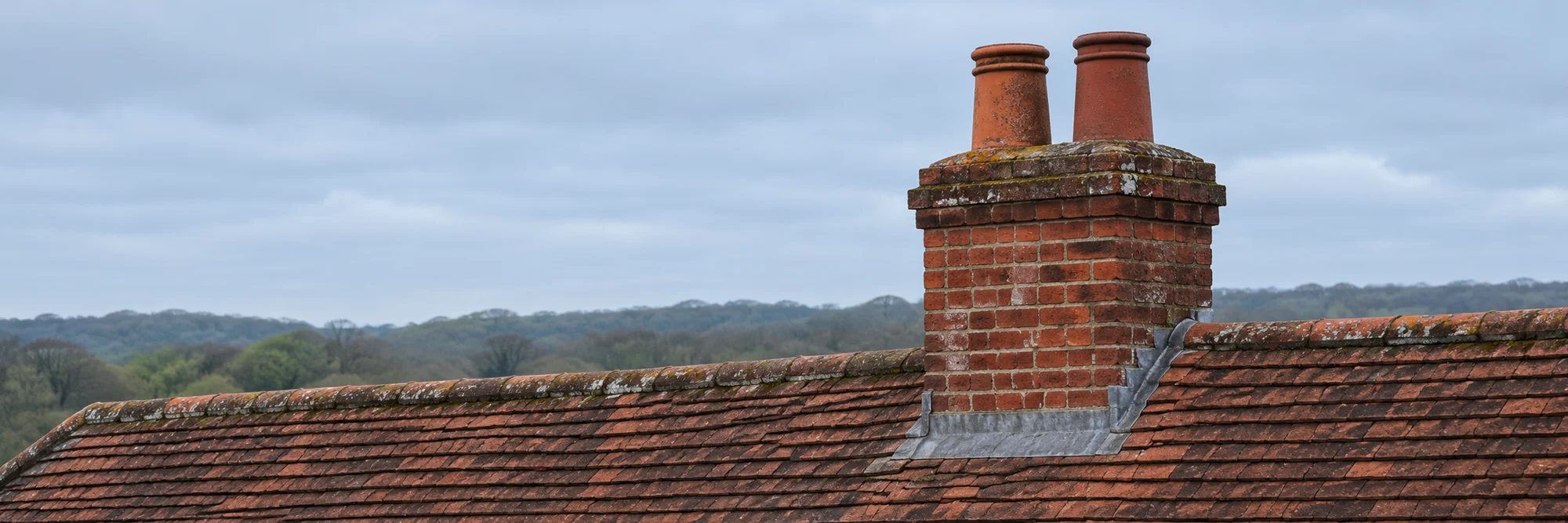
A stack with no fire below still takes the full force of the weather and needs the same pointing, flashing and flaunching as one in daily use, with scaffold every time. If you will never light a fire or fit a stove, it gives you only character and ventilation. Venting the breasts keeps the ventilation after removal; character is weighed below.
Leaning stacks
A slight lean is common on old stacks and not always dangerous. Tall, thin single-flue stacks lean most, often because the windward side stays wet and swells. A stack you want to keep can be rebuilt from the roofline. A pronounced lean on an unused stack is the clearest case for removal, since rebuilding costs the same scaffold and labour just to put it back.
Spalled brick and failed flaunching
Flaunching, the sloped mortar cap around the pots, is usually the first part to fail, and on its own is a small repair. Spalling spreads: once a brick's hard face blows, the soft core soaks up water and damages its neighbours. A few bricks can be replaced, but spalling across several faces means a part rebuild at £500 to £2,500, close to the cost of removal.
When a stack keeps leaking
If damp returns after re-flashing or repointing, diagnose before paying for another patch. Water can enter through flashings, brick, flaunching or an open pot, and fixing one route while another stays open is why repairs fail. On an unused stack, removal closes every route at once; on one you use, do all the repairs together. See lead flashing and repointing.
Lifetime maintenance against one-off removal
Removal costs more than any single repair but happens once. Repairs recur, usually with scaffold each time, so compare a typical round of repairs with removal on the same house.
| Option | Guide cost | Then what |
|---|---|---|
| Repointing | £450 – £1,200 | Flashing and flaunching still to maintain |
| Repointing plus full flashing replacement | £850 – £2,150 | Plus scaffold if quoted separately: £800 – £1,500 |
| Full rebuild from the roofline | £2,000 – £5,000+ | A sound stack that still needs future upkeep |
| Stack removal, scaffold and roof included | £1,800 – £3,500 | Nothing left above the roof to maintain |
Guide ranges from published 2026 cost guides, not quotes. Check whether repair quotes include scaffold.
Once repairs need scaffold, they can match removal. See the stack removal cost guide.
When the stack matters to the street
In a conservation area or on a listed building, the council may want the stack kept, whatever the maintenance sums say. Matching stacks give a terrace a continuous skyline, and losing one leaves a gap.
A failing protected stack is usually repaired or rebuilt like for like. See our regulations guide.
Keeping the stack but stopping using it
If you keep a stack you no longer use, cap the pots with ventilated cowls and fit a vent at the bottom of each breast. Never seal a flue tight at both ends, or trapped moisture brings salt staining. Capping does nothing for the outside of the stack, which still needs pointing and flashing. If you decide to take it down, see how chimney stack removal works.
Sources and further reading
- Planning Portal: do I need permission to remove a chimney stack in a conservation area
- Brighton & Hove City Council: Article 4 direction, The Avenues
- Brighton & Hove City Council: Article 4 directions
- Brighton & Hove City Council: Article 4 direction, Ovingdean conservation area
- Brighton & Hove City Council: Article 4 direction, North Laine
- South Downs National Park Authority: making a planning application
- Homebuilding & Renovating: restoring chimneys (leaning stacks, sulphate attack)
- Department for Communities NI: domestic chimneys and flues (capping and ventilating unused flues)
- Richmond Council: chimney stack removal and the Building Regulations (ventilated caps, damp)
- Historic England: open fires, chimneys and flues
- Bradford Council: chimneys in conservation areas
- gov.uk: Party Wall etc. Act 1996 explanatory booklet