- Patch repair
- Around £200
- Full replacement
- £400 – £950
- Usual material
- Rolled lead sheet, Code 4 or heavier
- Time on site
- Usually a day once access is up
- Permission
- Not normally needed; lead-free on a listed building may need consent
- Check alongside
- Flaunching, pointing and the back gutter outlet
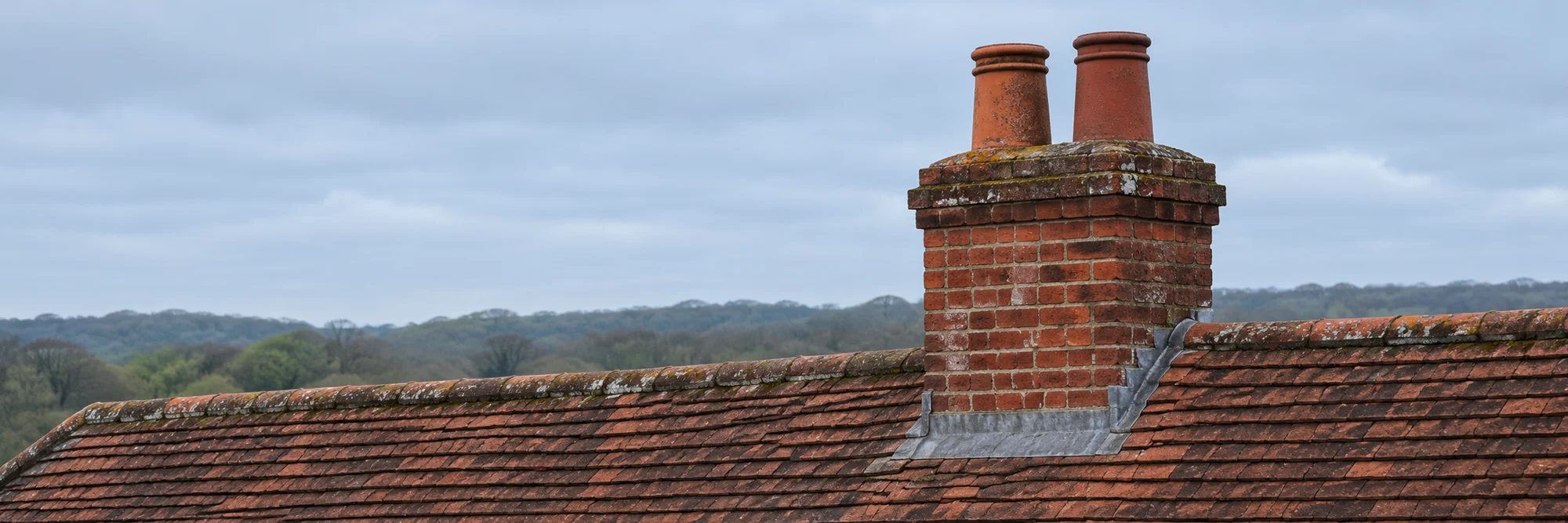
The parts of chimney leadwork
Chimney leadwork is a set of separate pieces that overlap so water always runs down and out, never in. Each piece is made separately so it can expand and contract on its own without tearing.
| Part | Where it is | What it does |
|---|---|---|
| Front apron | Downslope face of the stack | Dressed over the tiles or slates below the stack and turned up the brickwork |
| Soakers | Sides of the stack, under each slate or tile | Small bent sheets laid in with each course so water that gets past the flashing runs back onto the roof |
| Step flashing | Sides of the stack, over the soakers | Cut in steps that follow the brick courses, each step turned into a mortar joint |
| Back gutter | Upslope face of the stack | A small lead-lined gutter that catches water coming down the roof and turns it round the sides |
| Cover flashing | Over the back gutter upstand | Lapped over the back gutter so water cannot run behind it |
Slate and plain clay tile roofs, the usual coverings on Victorian terraces in Brighton and Lewes, use soakers with step flashings over them. Interlocking concrete tiles on later houses usually take a step and cover flashing dressed over the tile profile instead.
Which lead codes are used and why
Lead sheet is sold by code, and a higher code means thicker, heavier lead. Code 4 is the common minimum for chimney aprons and step flashings. Soakers can be Code 3 or Code 4. Back gutters carry the most water and are often specified in Code 5, especially on wide stacks and exposed roofs.
Thicker lead resists wind lift and fatigue better but costs more and is harder to dress tightly over slate. Piece length matters as much as thickness: industry guidance limits flashing pieces to about 1.5 metres, lapped at the joints, so thermal movement is spread out instead of building up and cracking the sheet.
How chimney flashing fails
Most flashing leaks come from one of four faults, usually visible from scaffold.
Lifted lead
Wind gets under a loose edge and peels it back, most often on the apron or the windward step flashing. Coastal stacks from Hove to Seaford take this hardest in winter gales.
Splits from thermal movement
Lead expands in sun and shrinks at night. Pieces that are too long, or fixed too tightly at both ends, fatigue and crack. Splits often appear at corners and folds.
Mortar fillets instead of lead
Some stacks have a sloped mortar fillet where the leadwork should be. Mortar and brick move differently from the roof, so a fillet cracks and lets water straight down the side of the stack. This is a common reason a chimney keeps leaking after "repairs".
Lead slipping out of a shallow chase
Each step should be turned at least 25 mm into a mortar joint and held with lead wedges, then pointed, as Lead Sheet Association technical guidance describes. When the chase is too shallow or the pointing over it has failed, the lead pulls out and water runs behind it.
A blocked back gutter behind the stack does the same job by overflowing. Leaves and moss are the usual cause, most of all under mature trees.
Repair or replace chimney flashing
A patch repair is enough when the rest of the leadwork is sound and the fault is one piece: a lifted apron re-dressed, one split step replaced, or a chase re-wedged and repointed. Full replacement makes sense when there are several splits, the lead is thin and brittle, a mortar fillet needs replacing with proper leadwork, or the stack is being repointed or rebuilt anyway.
Patch repair if
- One piece has lifted or split
- The lead is otherwise flexible and well fixed
- The chases are deep enough and only the pointing has failed
Replace if
- Splits on several pieces or corners
- Mortar fillets instead of soakers and steps
- The back gutter is undersized or overflows
- The stack is being repointed or rebuilt
Silicone or bitumen tape over a split may buy a few months, but it does not fix the cause. If the stack is unused and the leadwork, pointing and flaunching all need doing, compare the total with removing the stack, which takes the flashing away entirely.
Lead-free flashing: when it is acceptable
Lead-free flashings are flexible, self-adhesive sheets made to be dressed like lead. They are lighter, have no scrap value, so are unattractive to thieves, and can suit modern concrete tile roofs and low-risk abutments.
They are less suited to listed buildings and to many houses in conservation areas, where lead is the traditional material. Historic England's starting point after metal theft is like-for-like replacement, and switching material on a listed building generally needs listed building consent. In Brighton and Hove and Lewes, where many Victorian and Regency streets are in conservation areas, check with the council before choosing an alternative. Our regulations guide explains who to ask.
Lead flashing cost
| Job | Guide range |
|---|---|
| Lead flashing patch repair | Around £200 |
| Lead flashing full replacement | £400 – £950 |
| Chimney scaffold, two-storey house | £800 – £1,500 (up to about £2,500 for difficult access) |
Typical guide prices from published 2026 cost guides, not quotes. Brighton and the South East usually sit in the upper half.
Access often costs more than the leadwork itself. Not sure the flashing is the cause? See the chimney leak repair guide.
Sources and further reading
- Building Conservation Directory: The Ins and Outs of Weathering to Walls (Fred Coote, Lead Sheet Association)
- Lead Sheet Training Academy: Rolled Lead Sheet, The Complete Manual
- NHBC Standards 7.2.20: Weathering details
- The Lead Lads: Lead for chimneys, aprons, soakers and back gutters
- Historic England: Theft of Metal from Church Roofs, Replacement Materials
- Klober: Lead-free flashing guide
- Royston Lead: Cast lead sheet brochure (thermal movement and piece size)