- Postcode
- BN9
- Planning authority
- Lewes District Council (South Downs National Park Authority for land inside the park)
- Building Control
- Lewes District Council Building Control (run directly by the council)
- Scaffold licence
- East Sussex Highways, for East Sussex County Council
- Typical housing
- Late Victorian and Edwardian terraces; post-war semi-detached estates on the slopes
- Conservation areas
- Newhaven (Church Hill), Newhaven (Denton); South Heighton next door
Houses and chimneys in Newhaven
Newhaven grew as a railway and ferry port after the line arrived in 1847. Its historic character survey records terraces on Meeching Road, South Road and Chapel Street by about 1875, more along Fort Road and Railway Road by the harbour, and a second wave off the Lewes and Brighton roads, such as Elphick Road and Lawes Avenue, by about 1900.
Unusually for a south coast town, Newhaven saw very little of the detached houses and bungalows typical of the interwar years; modest terraces kept being built instead, reflecting the port's workforce. After 1945 the built-up area tripled, with council and private estates of mostly semi-detached houses spreading west up the downland slope. East of the river, post-war housing engulfed the old village of Denton, and Mount Pleasant sits on the same exposed chalk slope.
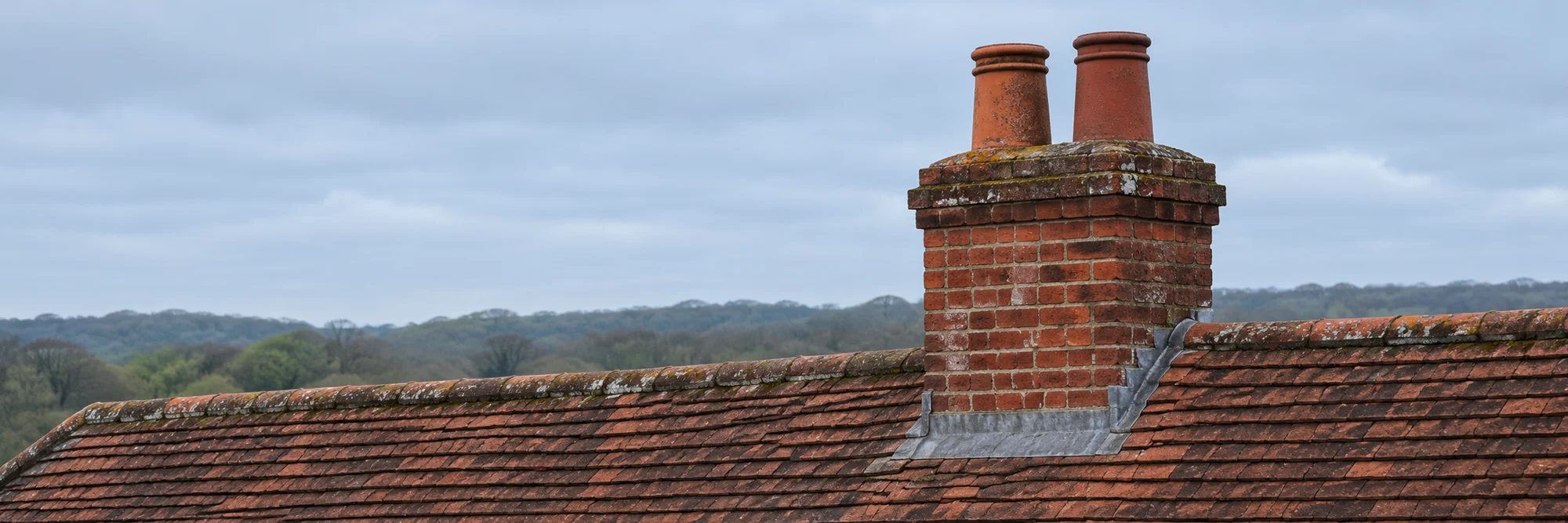
- Victorian and Edwardian terraces: a stack on the party wall serving the front and back rooms of both houses, often with several pots.
- Post-war semis: one stack on the shared wall, serving both halves.
- Hillside houses in Denton, Mount Pleasant and Harbour Heights: short stacks but high exposure to wind and driven rain.
Why Newhaven homeowners remove chimney stacks
Age and weather drive most Newhaven enquiries. Terrace stacks from the 1870s to 1900s have had over a century of salt air from the harbour mouth, and houses on the upper slopes take the wind straight off the Channel. Typical findings are eroded joints, cracked flaunching, loose pots and lifted lead.
- Survey reports flagging a leaning or spalling stack on a terrace purchase.
- Damp on the party wall breast in a front bedroom, often from a failed stack or flashing. Start with chimney leak repair.
- Kitchen and bedroom space in narrow terraces, where a breast takes a real share of a small room.
- Unused flues in post-war semis now heated by gas or electricity. If the stack is sound, see repair or remove.
Chimney stack removal in Newhaven
Access is the main cost factor. The neighbourhood plan describes a town that rises steeply on both sides of the valley, with homes reached by steep streets. On a sloping street the scaffold needs building up on the downhill side, and with no side access almost every terrace job puts scaffold on the pavement. That needs a section 169 licence from East Sussex Highways, applied for by the scaffolder.
Roof coverings vary street by street. Slate was shipped into the port as a building material historically, and the historic survey notes clay tiles on the older town buildings. Whatever is on your roof, the patch where the stack stood has to be matched, and on a terrace that means matching your neighbour's roof line too.
Chimney breast removal in Newhaven
In a terrace the breast is built into the party wall and the stack above is often still carrying your neighbour's flues. Taking out a ground floor breast means supporting everything above it, usually on a steel beam designed by a structural engineer, and serving a party wall notice on next door before work starts.
Post-war semis are simpler: one stack on the shared wall, and both breasts are often removed together when both owners agree. See our chimney breast removal guide.
Permissions in Newhaven
Newhaven has two conservation areas, both designated by Lewes District Council: Newhaven (Church Hill), a small area around St Michael's church, its churchyard and the rectories, and Newhaven (Denton), around St Leonard's church. Ask the council before removing a visible stack in either.
- South Heighton, north of Denton, has its own conservation area, and the South Heighton (Norton) conservation area is mapped by the South Downs National Park Authority.
- Article 4: the council's Article 4 direction in Newhaven covers changes of use in commercial areas, not chimneys on houses.
- Listed buildings: the neighbourhood plan counts 21 in the parish. Any work to a listed chimney needs listed building consent.
- Building Regulations: breast removal needs approval from Lewes District Council Building Control, with fees on its charges schedule.
The South Downs National Park surrounds the town but its residential areas sit outside it; inside the park, the National Park Authority has decided applications itself since 1 April 2026. Elsewhere in the town, stack removal on an ordinary house does not normally need planning permission. Our regulations guide explains the rules in full.
Chimney stack removal cost in Newhaven
Terraces on steep streets usually sit in the upper half of the two-storey range; a large shared stack can reach the top band. Post-war semis fall nearer the middle.
| Job | Guide price |
|---|---|
| Stack removal, typical two-storey house, scaffold included | £1,800 – £3,500 |
| Stack removal, tall terrace, large or shared stack | £3,000 – £6,000 |
| Chimney scaffold, two-storey house | £800 – £1,500 (up to about £2,500 for difficult access) |
| Chimney breast removal, ground floor only, with support above | £1,500 – £3,000 |
| Chimney breast removal, both floors, stack kept and supported | £3,000 – £5,000 |
Guide ranges from published 2026 cost guides, not quotes. Party wall surveyor fees and the scaffold licence are extra. See the breast removal cost guide.
Send your address and a photo of the stack through the quote form for a price.
Sources and further reading
- Sussex Extensive Urban Survey: Newhaven Historic Character Assessment (Roland B Harris, 2004)
- Newhaven Neighbourhood Plan, submission version (steep streets, Denton and Mount Pleasant, Article 4, listed buildings)
- Wikipedia: Newhaven, East Sussex (postcode, railway 1847, neighbourhoods)
- HeritageCheck: Newhaven (Church Hill) Conservation Area
- HeritageCheck: Newhaven (Denton) Conservation Area
- HeritageCheck: South Heighton Conservation Area
- Planning data: Newhaven conservation area entries
- South Downs National Park Authority: Lewes and Eastbourne conservation area maps
- South Downs National Park Authority: Update on Lewes planning (services returned to SDNPA 1 April 2026)
- Lewes District Council: Conservation area appraisals
- Lewes District Council: What is building control
- Lewes District Council: Building control charges
- East Sussex Highways: scaffolding licence (section 169)
- GOV.UK: Party Wall etc. Act 1996 guidance