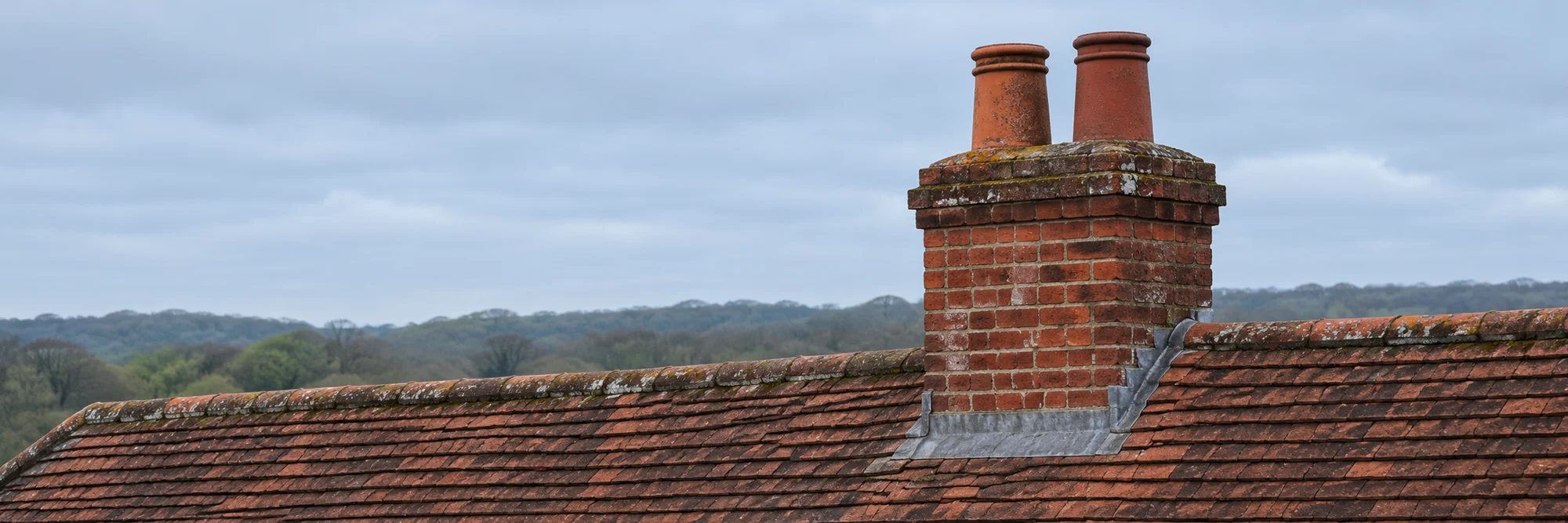
- Typical repairs
- Pots, cowls, flaunching, repointing, flashing, partial rebuild
- Repointing guide price
- £450 – £1,200
- Partial rebuild guide price
- £500 – £2,500
- Access
- Usually scaffold or a tower; scaffold is often the largest single cost
- Permission
- Like-for-like repairs normally need none; listed buildings are different
- Disruption
- Mostly outside; little or no work indoors
Chimney symptoms, causes and fixes
Start with what you can see from the street, the garden or the loft; binoculars from across the road help. The table links each symptom to its most likely cause and usual fix.
| What you see | Likely cause | Usual fix |
|---|---|---|
| Pot loose, cracked or leaning; bits of terracotta in the gutter | Flaunching around the pot has cracked and lost its grip | Reset or replace the pot and renew the flaunching |
| Cracked or crumbling mortar slope around the pots | Frost and weather have broken up the flaunching | Hack off and renew the flaunching |
| Gaps between bricks, mortar falling out, sand on the roof | Pointing has weathered back | Repointing, ideally in lime on older stacks |
| Brick faces flaking or crumbling | Frost and salt damage to saturated brick, often made worse by hard cement pointing | Cut out and replace bricks, repoint; rebuild the top if widespread |
| Stack visibly leaning or bowed | Mortar joints expanding on the wet side, often from sulphate attack | Partial or full rebuild, or removal |
| Render cracked, bulging or falling off | Render has debonded and is holding water against the brick | Strip and re-render, or expose and repoint |
| Damp patch on chimney breast or ceiling | Flashing, porous brick, an open flue or salts in the plaster | See chimney leak repair |
| Water at the junction with the roof, stains on rafters in the loft | Lifted, split or missing leadwork | Lead flashing repair or replacement |
A table like this narrows the options. It does not replace a close inspection from scaffold or a tower.
Pots, cowls and flaunching
A loose or cracked pot is almost always a flaunching problem. Flaunching is the sloped mortar bed on top of the stack that holds the pots and throws rain off. It takes the worst of the weather, so it usually fails before anything else, and once it cracks the pots work loose in high wind.
The fix is to lift the pots, hack off the old flaunching, re-bed the pots and form a new slope. Broken pots are best replaced with matching ones. On an unused flue, fit a ventilated cap that keeps rain out but lets air through.
This site's price guide does not cover these smaller jobs. As a published reference, MyJobQuote's 2026 guide gives about £150 – £300 for flaunching repair, £300 – £500 for a replacement pot and £200 – £400 for a replacement cowl. Scaffold or tower access can cost more than the work itself, which is why it makes sense to do every job the stack needs on the same visit.
Spalled, frost-damaged brick and failed pointing
Flaking brick faces mean the brick has been staying wet and then freezing, or salts have been crystallising just under the surface. A stack is the most exposed brickwork on the house, and between Hove and Seaford it also takes wind-blown salt spray.
Hard cement pointing on a soft old brick makes this worse, because water leaves through the brick instead of the joint. A few spalled bricks can be cut out and replaced. Where most of the top courses have gone, a partial rebuild is usually cheaper over time than patching. The mortar side of this, including lime versus cement, is covered in our chimney repointing guide.
Leaning chimney stacks
A stack that leans has usually been pushed over by its own mortar. Flue gases leave sulphates in the brickwork; when the joints stay wet, those sulphates react and the mortar swells. The wetter, more exposed face grows taller than the sheltered one and the stack bends away from it. Tall, slender stacks are most at risk.
A small lean is common on old stacks, but a pronounced or worsening one needs assessing. A lean can also come from a chimney breast removed below without proper support, which is more serious. Repointing rarely cures a lean: the usual choices are rebuilding from below it or taking the stack down.
Render failure on rendered and painted stacks
Many Regency and early Victorian houses in Brighton and Hove have rendered or painted stacks to match their stucco fronts. Once render cracks, rain gets behind it and cannot escape, so the brick behind stays wet and the render debonds further. Hollow-sounding patches, bulges and pieces on the roof are the signs.
Patching hard render over a damp stack moves the problem rather than fixing it. The lasting repair is to strip the failed render, let the stack dry, repair the masonry and re-render in a breathable mix. Painted stacks need a breathable masonry paint, not a coating that traps water.
Partial and full chimney rebuilds
A rebuild is needed when the brickwork itself has failed, not just the mortar. A partial rebuild takes the stack down to sound brick, usually the top few courses, and rebuilds it with new or salvaged brick and fresh flaunching. A full rebuild takes it down to the roofline.
| Job | Guide range |
|---|---|
| Partial stack rebuild (top courses) | £500 – £2,500 |
| Full stack rebuild from the roofline | £2,000 – £5,000+ |
| Chimney repointing | £450 – £1,200 (up to £1,600 for large stacks) |
Typical guide prices from published 2026 cost guides, not quotes. Brighton and the South East usually sit in the upper half; tall terraces, shared stacks and awkward scaffold access push prices higher.
A rebuild should use a mortar suited to the brick, with new leadwork and flaunching. On a shared terrace stack the work affects the neighbour's side too; see the regulations guide.
When repair stops making sense
Repair stops making sense when the stack serves no fire, needs scaffold every few years, and the next job is a rebuild. At that point removal can cost a similar amount and ends the maintenance for good. Our repair or remove guide sets the two options side by side.
Repair usually makes sense if
- You use the fireplace or may want to
- The stack is sound apart from mortar, pots or flashing
- It is a listed building or a stack that matters to the street
- The stack is shared and your neighbour wants to keep theirs
Removal is worth pricing if
- No flue below is in use
- The stack leans or needs a full rebuild
- It has leaked more than once despite repairs
- You are reroofing, converting the loft or fitting solar panels
Like-for-like repairs do not normally need planning permission. Listed buildings, and some changes in conservation areas, can need consent even for repairs that alter appearance, so check with the council first. Full detail is in our regulations guide.
Chimney repairs in Brighton & East Sussex
Stacks along the coast from Hove to Seaford take wind-driven rain and salt from the south-west, so flaunching, pointing and exposed brick faces wear faster than on sheltered inland stacks in Lewes or the Downland villages. Victorian terraces across Brighton and Lewes often share one stack between two houses, and roofs are commonly Welsh slate or clay tile, which matters when leadwork or roof coverings around the stack are disturbed.
Sources and further reading
- Building Conservation Directory: Chimneys and Flues (Russell Taylor)
- SPAB: Repointing advice
- Historic England: Repointing Brick and Stone Walls
- MyJobQuote: Chimney repair cost (2026)
- Inspectapedia: Curved chimneys and sulphation
- Wikipedia: Bungaroosh
- Cotswold District Council: Chimneys (cites Historic England HEAG 080)
- North Herts Council: Consent for work to a listed building