- Postcode
- BN25
- Planning authority
- Lewes District Council for the town; South Downs National Park Authority for the park, including Bishopstone
- Building Control
- Lewes District Council Building Control (run directly by the council)
- Scaffold licence
- East Sussex Highways, for East Sussex County Council
- Typical housing
- Flint and brick old town, Victorian terraces, interwar and post-war detached houses and bungalows
- Conservation areas
- Seaford Town Centre, East Blatchington, Chyngton Lane, Bishopstone
Houses and chimneys in Seaford
The historic town sits on higher ground set back from the modern seafront, around St Leonard's church. Its historic character survey describes pre-railway buildings dominated by flint or cobble, a timber-framed house on the High Street hidden behind a later flint-cobble front, and tile-hung cottages on Steyne Road beside the stuccoed 1-4 Marine Terrace.
The railway reached Seaford in 1864. Large terraces followed on Pelham Road by 1873, then streets near the station and north towards East Blatchington (Claremont, Chichester, Brooklyn, Grosvenor, Kedale and Salisbury Roads) before 1922, with slower building along Sutton Park Road, Grove Road and Stafford Road. Interwar and post-1945 suburbs then swallowed the old settlements of East Blatchington, Sutton and Chyngton, until by 2005 the town was larger than Lewes.
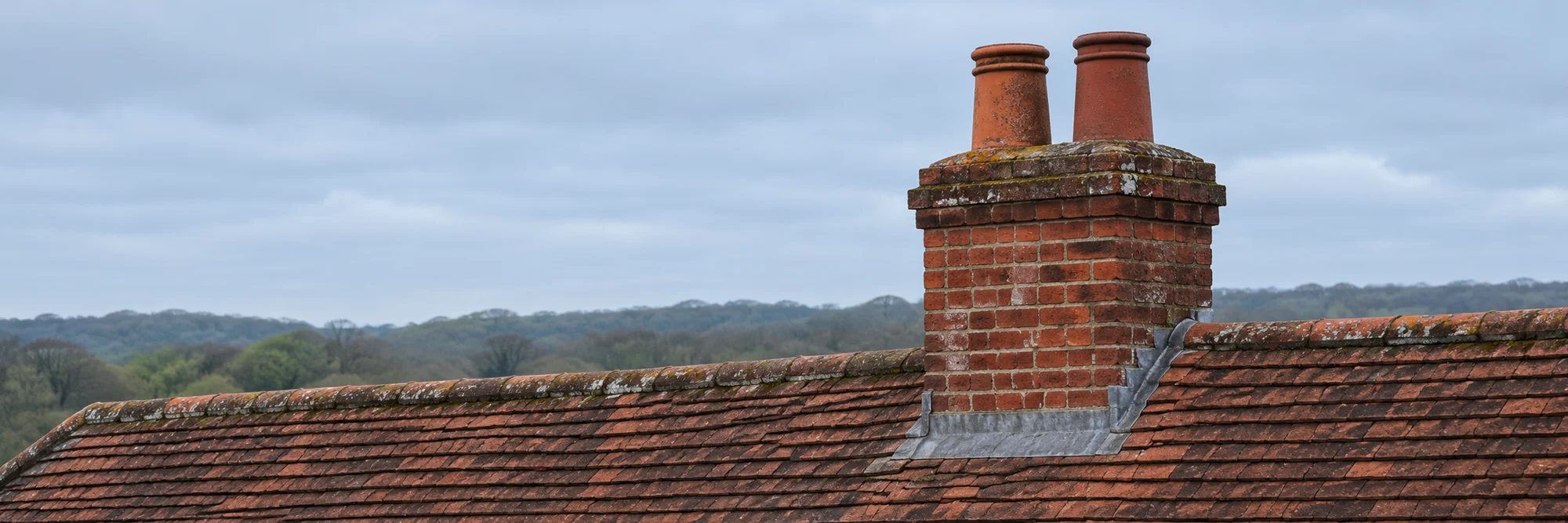
- Old town: flint and brick cottages with low, often rebuilt stacks on clay tile or slate.
- Victorian terraces around Blatchington Road, Richmond Terrace and Pelham Road: stacks on the party wall, shared with next door.
- Large detached houses on Firle Road, Chyngton Road and Cuckmere Road: several stacks, often tall, in generous gardens.
- Post-war estates such as Chyngton Way, with bungalows on the south side: one modest stack each.
Why Seaford homeowners remove chimney stacks
Seaford Bay is an open shingle beach between Castle Hill and Seaford Head, and the seafront has a long record of storm damage: the first sea wall, begun in 1865, was destroyed in storms in 1875. Houses on the seafront roads and the higher ground at Chyngton take salt spray and south-westerly gales full on, which shortens the life of mortar, flaunching and lead.
- Downsizing and maintenance: at the 2011 census, people aged 65 and over made up about 30% of Seaford parish, nearly double the England average. Many owners want fewer high-level maintenance jobs.
- Several redundant stacks on large Edwardian and interwar houses, where removing some and keeping one is common.
- Damp around the breast on exposed elevations. Diagnose first with our chimney leak repair guide.
- Bungalow loft rooms, where the stack blocks a dormer.
Chimney stack removal in Seaford
Access varies more in Seaford than in most towns. Detached houses on Firle Road or Chyngton Road usually allow scaffold inside the garden, and several roads in the Chyngton area are private and unmade, which is relevant to licensing. In the old town and on terraced streets near the station, scaffold usually stands on the pavement and needs a licence from East Sussex Highways under section 169 of the Highways Act 1980. Private roads not used as a public right of way need no licence.
On the seafront, plan for weather. Work may pause in a gale, and the opening must be weathertight every night. Roofing materials should match what is there: clay tile or slate in the old town, and the existing covering on later houses.
Chimney breast removal in Seaford
On Victorian terraces, breasts are built into the party wall, so removing one means steel support for the breast or stack above and a party wall notice to next door. Large detached houses often have breasts on external walls instead, which avoids party wall issues but may mean a tall stack to support or remove.
In pre-railway flint cottages, the chimney may be holding up more of the house than it appears to. A structural engineer should look before any breast is cut out. See our chimney breast removal guide.
Permissions in Seaford
Seaford has four conservation areas. If your house is in one, ask the planning authority before removing a stack visible from the street, as chimneys often contribute to the character the area protects.
- Seaford Town Centre (designated 1969, extended 1976 and 1988): the old town around the High Street, Church Street and Steyne Road, with 31 listed buildings.
- East Blatchington (1976, extended 1988): the old village around St Peter's church.
- Chyngton Lane (1990): the former farmstead at Chyngton House.
- Bishopstone (1976): the downland village west of the town, inside the South Downs National Park.
Most of the town is planned by Lewes District Council, which publishes its conservation area appraisals. The neighbourhood plan records that 61.4% of Seaford parish lies in the National Park, where the South Downs National Park Authority is the planning authority and, since 1 April 2026, decides those applications itself rather than through Lewes District Council. Breast removal needs Building Regulations approval from Lewes District Council Building Control, charged on its fee schedule. Our regulations guide has the detail.
Chimney stack removal cost in Seaford
Post-war bungalows sit at the lower end. Large houses with several tall stacks, and old town properties needing lime and flint work, sit higher.
| Job | Guide price |
|---|---|
| Stack removal, bungalow, roof made good, scaffold included | £1,200 – £2,000 |
| Stack removal, typical two-storey house, scaffold included | £1,800 – £3,500 |
| Stack removal, three-storey or tall terrace, large or shared stack | £3,000 – £6,000 |
| Chimney breast removal, first floor only | £1,750 – £3,200 |
| Partial stack rebuild (top courses), if you keep a stack | £500 – £2,500 |
Guide ranges from published 2026 cost guides, not quotes. Brighton and the South East usually sit in the upper half. See the stack removal cost guide.
Tell us which stacks you want gone using the quote form.
Sources and further reading
- Sussex Extensive Urban Survey: Seaford Historic Character Assessment (Roland B Harris, 2005)
- Seaford Neighbourhood Plan (conservation areas, 61.4% in National Park, 2011 age profile, Areas of Established Character, seafront)
- Wikipedia: Seaford, East Sussex
- HeritageCheck: Seaford (Town Centre) Conservation Area
- HeritageCheck: Seaford (East Blatchington) Conservation Area
- HeritageCheck: Seaford (Chyngton Lane) Conservation Area
- South Downs National Park Authority: Lewes and Eastbourne conservation area maps (Seaford Bishopstone)
- South Downs National Park Authority: planning applications
- South Downs National Park Authority: Update on Lewes planning (services returned to SDNPA 1 April 2026)
- Lewes District Council: Conservation area appraisals
- Lewes District Council: What is building control
- Lewes District Council: Building control charges
- East Sussex Highways: scaffolding licence (section 169)
- Planning Portal: Do I need permission to remove a chimney stack in a conservation area?
- GOV.UK: Party Wall etc. Act 1996 guidance