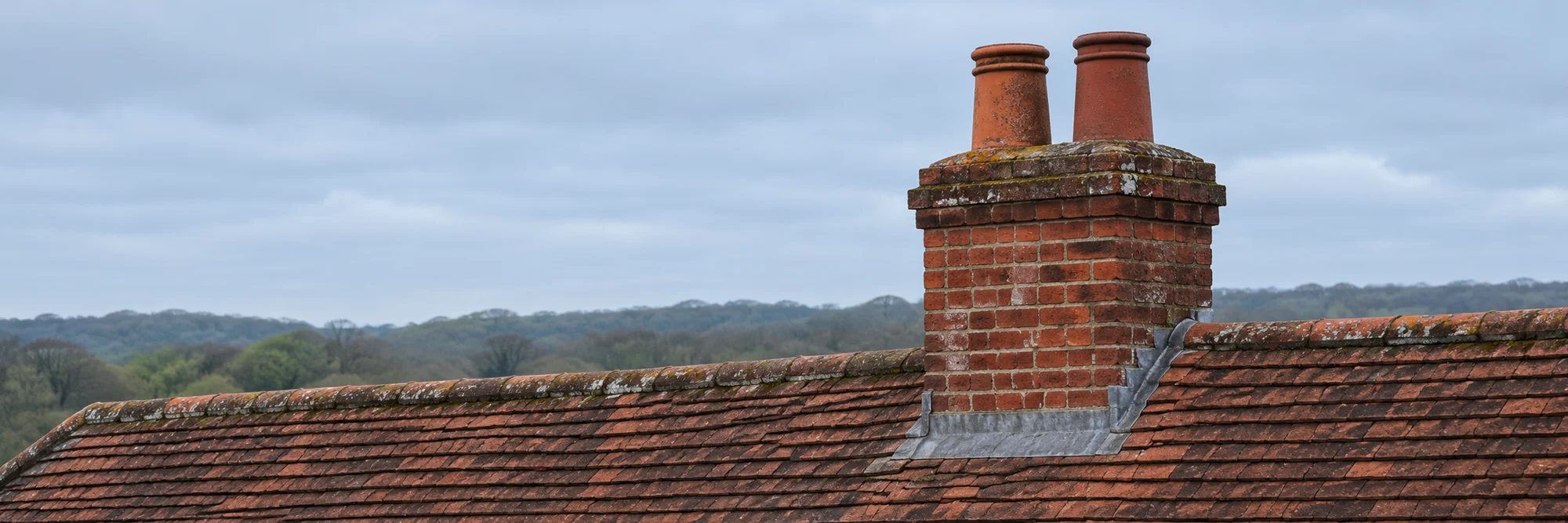
- Guide price
- £450 – £1,200 (up to £1,600 for large stacks)
- Scaffold, two-storey house
- £800 – £1,500
- Time on the stack
- Usually one to three days, plus scaffold up and down
- Best mortar for older brick
- Lime, weaker than the brick
- Permission
- Not normally needed for like-for-like work
- Done at the same time
- Flaunching, pots and flashing check
Signs your chimney needs repointing
Repointing is due when the joints have eroded back to roughly their own width, mortar crumbles when pressed, or sand and grit collect in the valley or gutter below the stack. Soft mortar on its own is not a reason to repoint if it is still in place: lime mortar is meant to be softer than the brick.
- Recessed joints that leave the brick edges exposed
- Mortar you can scrape out with a key or finger
- Plants or moss growing from the joints
- Hairline cracks running along the horizontal joints, which can mean the mortar is swelling
- Brick faces starting to flake beside hard, proud cement pointing
Weathering is rarely even, so repointing one or two exposed faces can be enough. If the brick itself is spalling or the stack leans, see the repairs hub for when a rebuild is needed.
Lime or cement mortar for a chimney
Use lime on soft, older brick. Historic England and the SPAB both advise that new mortar should be weaker and more permeable than the brick it bonds, so that moisture leaves through the joints and the mortar wears away first. The mortar is the part you are meant to renew; the brick is not.
Hard cement pointing reverses this. It is stronger and less permeable than a soft handmade or early machine brick, so water and salts move through the brick instead. Over winters of wetting and freezing, the brick face breaks away and leaves the cement standing proud. SPAB notes that cement pointing, particularly weather-struck cement, speeds up the decay of brick and stone.
Cement is not always wrong. Hard, dense bricks on a post-war stack can take a cement-lime mortar, and on stacks already damaged by sulphates a sulphate-resisting mix may be specified. The rule is that the mortar must suit the brick, not the other way round.
Matching mortar on Victorian and Regency stacks
Matching means matching the colour, texture and finish of the original, not just the strength. The best guide is the original mortar in a sheltered spot, such as under the flaunching or on the face away from the weather. The sand gives most of the colour, so the mix is usually adjusted with local sands until a small trial area dries to the right shade.
Regency and early Victorian stacks in Brighton, Hove and Lewes were built in lime, often in soft red or yellow stock brick, and many have since been patched in grey cement. Later Victorian terraces, such as those in Hanover, often show the same patchwork of original lime and later cement repairs. A flush or slightly recessed finish suits most of these stacks better than a raised or weather-struck joint.
How a chimney is repointed
Scaffold and inspect
Scaffold goes up and the whole stack is checked: pointing, brick faces, flaunching, pots and leadwork.
Rake out
Failed mortar is raked out by hand or with care, to about twice the joint width as SPAB advises, and deeper where joints are wide. Old cement is only cut out if it can be removed without breaking brick edges.
Clean and wet
Joints are brushed out and dampened so the new mortar does not dry too fast.
Point
New mortar is pressed in firmly in layers and finished to match the original profile.
Renew the flaunching
If the flaunching is cracked it is renewed at the same time, so the top of the stack is sealed against rain.
Protect and cure
Lime work is shielded from frost, rain and strong drying while it cures. That is why lime repointing is best planned outside the depths of winter.
Coastal salt and sulphate attack on Sussex stacks
Stacks between Hove and Seaford take wind-driven rain and salt spray off the Channel, so pointing on the exposed face wears faster than inland. Salts carried into the brick crystallise as it dries and push the surface off, the same flaking you see on seafront walls.
Inside the stack, sulphates left by years of coal fires react with wet mortar and make it swell. That shows up as cracks along the horizontal joints and, in bad cases, a lean. Repointing the outside does not cure sulphate damage deep in the joints, but it keeps the stack drier, which slows it down. If the joints are already swelling, the stack needs assessing before anyone quotes for pointing alone.
How long repointing lasts and what it costs
Good lime pointing on a sound stack should last many years and wears gradually rather than failing all at once. Cement on soft brick can look longer-lasting while the brick around it decays.
Repointing a chimney stack typically costs £450 – £1,200, rising to around £1,600 for large stacks. Scaffold for a two-storey house typically adds £800 – £1,500, or up to about £2,500 where access is difficult. Brighton and the South East usually sit in the upper half of these ranges, and tall terraces or shared stacks push prices higher. These are guide prices, not quotes.
Like-for-like repointing does not normally need planning permission, but a listed building can need consent if the work changes the mortar or appearance. Our regulations guide has the detail. If the stack is unused and the pointing is only one of several problems, compare the cost with removal.
Sources and further reading
- SPAB: Repointing advice
- Historic England: Repointing Brick and Stone Walls, Guidelines for Best Practice (2017)
- Building Conservation Directory: Chimneys and Flues (Russell Taylor)
- Department for Communities NI: Technical note, repointing stone and brick
- Inspectapedia: Curved chimneys and sulphation
- Inspectapedia: Spalling brick chimneys