- Time on site
- A few days for one floor; longer for both floors
- Guide price
- £1,500 – £3,000 for a ground floor breast with support above
- Planning permission
- Not normally needed for an internal breast; listed buildings need consent
- Who signs off
- Building Control (your council or a registered building control approver)
- Neighbours
- Party wall notice if the breast is on a shared wall
- Mess
- Heavy dust and soot, controlled with sheeting, sealed doors and extraction
What chimney breast removal involves
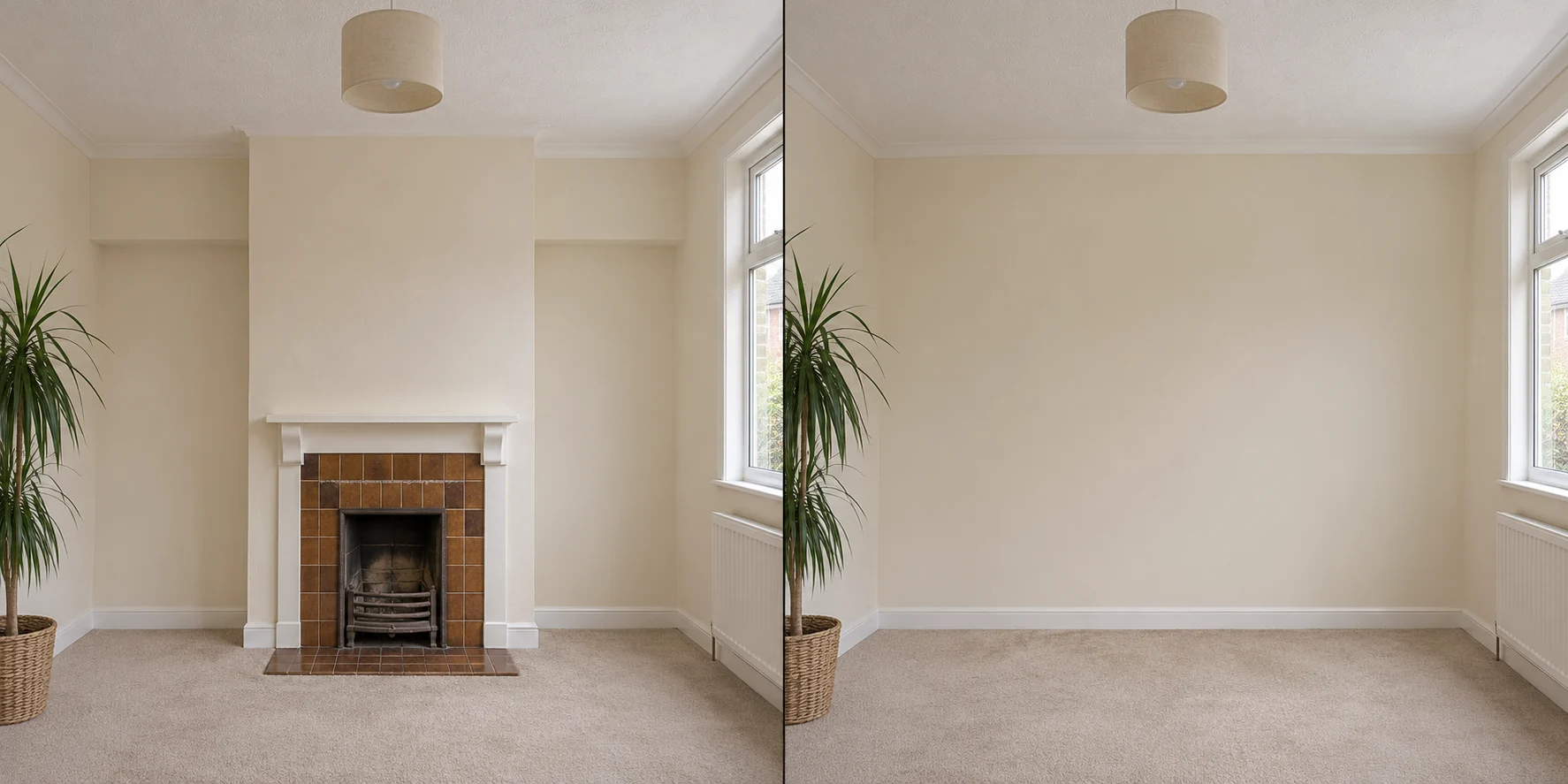
Removing a chimney breast means cutting the projecting brickwork back flush with the wall behind, then either taking out everything above or permanently supporting what stays.
Survey and design
We check what is above, which way the joists run, how sound the wall is and whether the breast backs onto a neighbour. An engineer sizes the support.
Approvals and notices
Building Control is notified, any party wall notice is served, and a Gas Safe registered engineer disconnects and caps any gas fire.
Protect the house
Floors are boarded, doorways sealed with zip doors and a dust extractor runs while cutting.
Prop and remove
Props hold the brickwork above while the breast and hearth are broken out by hand and bagged out.
Permanent support
The beam or brackets go in, packed tight and fire protected. Building Control inspects.
Make good
Floor, wall, ceiling and cornice are repaired and plastered. A final inspection leads to the completion certificate.
Removing one floor or every floor
You can take a breast out on one floor and leave the rest, or remove the whole chimney from ground to roof. The choice decides where the support goes.
- Ground floor only. Common where a front reception room is being opened up. The beam or brackets carry the first floor breast and the stack.
- First floor only. Often done for bedroom wardrobes. The breast below stays, but the chimney above still needs support.
- Both floors, stack kept. The support moves up into the loft and carries the stack, keeping the roofline unchanged, which matters in conservation areas.
- Full removal. Breasts and stack all come out, so nothing needs support, but it means scaffold and roof work. See chimney stack removal.
What holds up the chimney left above
The masonry left above a removed breast is carried either by a steel beam bearing on the walls each side, or by steel gallows brackets bolted to the wall behind. A beam is the more widely accepted option. Brackets are cheaper but many Building Control bodies now restrict them.
A beam bears on solid masonry at each end, usually on padstones, and is sized by the engineer from the load and span. Brackets rely entirely on their fixings and the wall they are bolted into. Councils have tightened their rules after brackets were fixed to walls that could not take them. Redbridge Council, for example, accepts brackets only with a structural calculation, a pull-out test of the fixings, and all of these:
- sound brickwork at least 215mm thick
- a breast no wider than 1,200mm, projecting no more than 340mm
- a house of no more than two storeys
- the neighbour's breast behind still in place
- the breast left below the roof at least as tall as the stack above it
Those are one council's criteria, not a national rule, but they show what engineers and Building Control check. On a thin, soft or already weakened party wall, expect a beam or full removal.
The neighbour's half and false breasts
In most Victorian and Edwardian terraces and semis, breasts sit back to back on the party wall with one shared stack. Remove your half and theirs relies on the support you install, so they get formal notice and the design protects their side.
We check first whether the neighbour has already removed their breast, because that thins the wall and usually rules out brackets. Gaps in the shared flue linings are repaired and, where possible, the neighbour's flue is smoke tested. The party wall process is covered in our regulations guide.
Not every breast is structural. Some newer houses have a boxed-in flue or a studwork fireplace surround with no masonry stack above. These are simpler to remove, but still need checking: a breast that looks false can hide a flue or a load.
Making good after a chimney breast comes out
A tidy finish needs a level floor where the hearth was, a repaired ceiling and cornice, a plastered wall, and time for that plaster to dry before you decorate.
- Hearth and floor. On suspended timber floors new joists and boards are let in; solid floors are filled and screeded. Original boards are not always matchable.
- Ceiling and cornice. Plain ceilings are patched and skimmed. Run plaster cornice in a period front room can be matched by a fibrous plasterer.
- Plastering. The exposed wall is dubbed out and plastered. Older solid walls may suit lime plaster better than gypsum.
- Drying. Deep backing coats take far longer to dry than a thin skim. Paint too soon and it blisters, so wait until your plasterer says the wall is ready for a mist coat.
How long it takes and how messy it is
A single floor breast is usually a few days on site, plus plastering and drying. Both floors take longer because the support goes into the loft. Old chimneys are full of soot and loose mortar, so expect sealed doorways, covered stairs, extraction and daily clearing.
How much space you gain, and what a buyer's surveyor looks for
The floor you get back is the breast's width multiplied by its projection, and the alcoves become straight usable wall. Measure yours before deciding.
When you sell, a buyer's surveyor looks for a breast missing below while the chimney still shows above, then checks the loft and ceilings for support, cracking or sagging. The buyer's solicitor will ask for the completion certificate. If a previous owner removed a breast without sign-off, see regularisation.
Do you need permission to remove a chimney breast?
An internal breast does not normally need planning permission, but it always needs Building Regulations approval because it is structural. A breast on a shared wall needs a party wall notice, and a listed building needs listed building consent. Our regulations guide covers each, and who handles them locally.
What chimney breast removal costs
Guide prices are about £1,500 to £3,000 for a ground floor breast and £3,000 to £5,000 for both floors with the stack kept, with Brighton and the South East usually in the upper half. Fees are extra. See the chimney breast removal cost guide.
Sources and further reading
- Planning Portal: Do I need permission to remove chimney breasts?
- Redbridge Council: Chimney breasts removal (gallows bracket criteria)
- East Suffolk Council: Removing a chimney breast (guidance note)
- Luton Council: Chimney breast removal inspection schedule
- Designing Buildings: Bungaroosh
- Legislation.gov.uk: Party Wall etc. Act 1996, section 2
- HSE: Gas safety for home owners